![[object Object]](https://img-va.myshopline.com/image/store/2000678933/1663746048441/39b6b7c932914f9586953fa6dbb3e95c.png?w=1694&h=200)
How to Choose Lace Trim for Necklines, Sleeves & Hems
Sep 23,2026 | LaceFabricShop
Introduction: Choose the Trim for the Garment Area
The same lace trim can look refined at a neckline and feel too heavy at a hem. A narrow edging that works beautifully on a fitted sleeve may disappear on a full skirt, while a wide decorative border can overwhelm a delicate collar. Choosing lace trim is therefore less about finding a universally ‘best’ style and more about matching the trim to the place where it will be sewn.
For dressmakers, designers and sewing makers, the practical questions are straightforward: How wide should the trim be for this area? Does the edge need to follow a curve? Should the trim stretch with the garment? Does its visual weight match the base fabric? This guide focuses on those decisions for necklines, sleeves, cuffs, hems, waistlines and other garment edges.
1. Start With the Garment Area
Begin by identifying the exact edge or seam where the lace will be applied. The location determines the amount of movement, contact with the body, visibility and sewing control required.
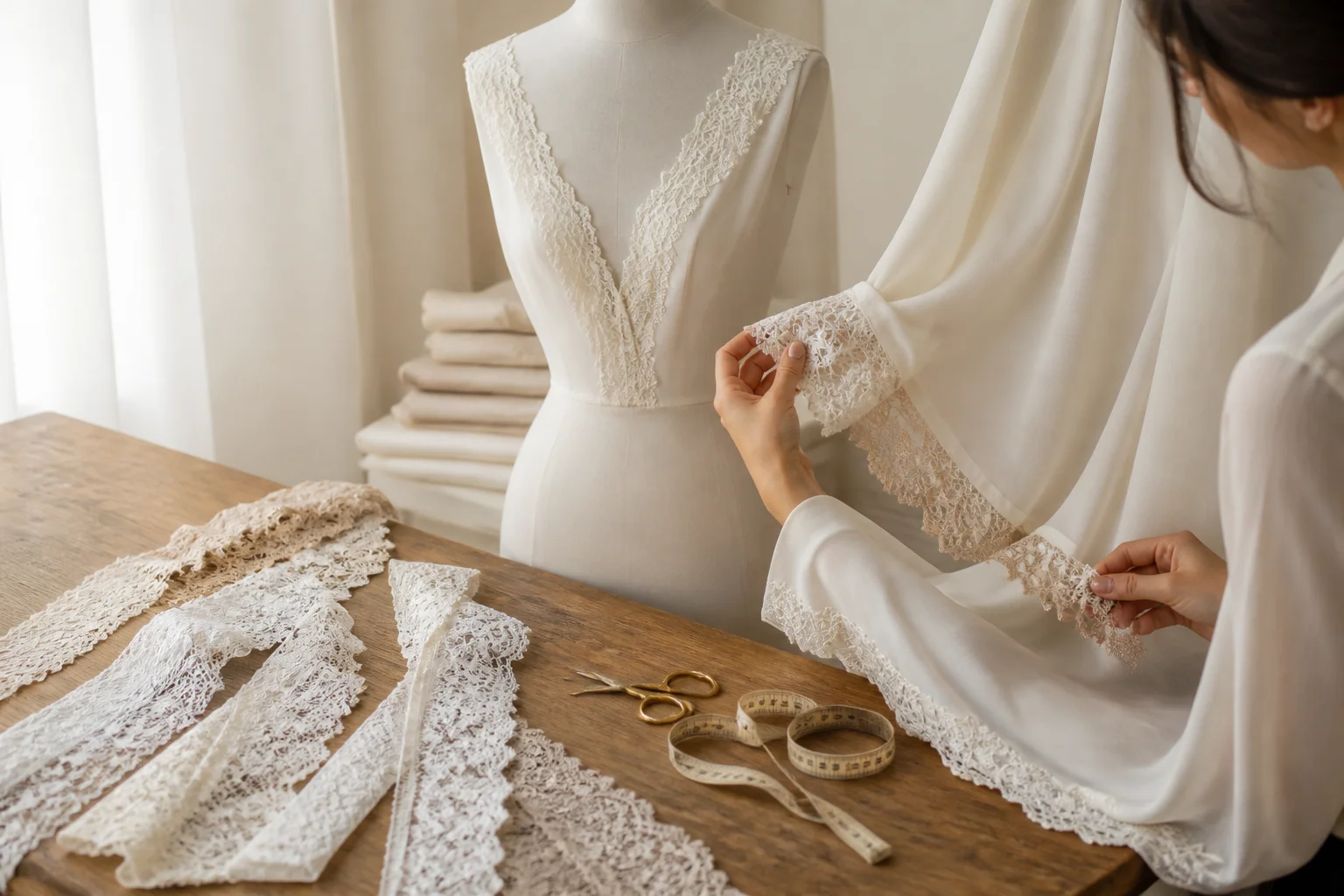
- Necklines: Consider the curve, skin contact, neckline depth and whether the lace should define the edge or sit slightly inside it.
- Sleeves and cuffs: Check how much the sleeve moves and whether the trim must flex when the arm bends. A cuff also needs a clean joining point.
- Hems: A hem can carry a visible decorative border, so width, edge shape and proportion become more important than they would be on a small seam.
- Waistlines and seams: The trim may need to cover a join without creating bulk or interrupting the garment’s line.
- Other garment edges: Consider pocket openings, lapels, lingerie edges, veil borders and accessory projects as separate applications rather than assuming one trim suits all of them.
2. Choosing Lace Trim for Necklines
Neckline trim is usually read close to the face, which makes proportion and edge control especially important. A narrow trim can create a quiet outline on a simple neckline. A wider trim can become a focal feature, particularly when the garment itself is understated.
For a delicate look, compare the trim’s finished edge with the neckline curve. A straight inner edge may be easier to align along a clean, stable opening, while a decorative scallop or eyelash edge can become part of the visible neckline design. Neither is automatically better: the right choice depends on whether the edge should look crisp, soft, graphic or ornamental.
On a curved neckline, check the trim’s flexibility and the distance between motifs. A trim with a strong directional pattern may require careful placement so that the design does not twist or appear uneven around the curve. Before stitching, place the trim around the neckline without sewing and inspect the overlap, joining point and symmetry.
For a real catalog example, LaceFabricShop lists Lace Trim for Garment Embellishment LT0192 as an active product. Its recorded options include 100x1.8 cm, 100x2.5 cm and 100x3 cm variants, with white and black options shown in the product data. Those are product-record details for this SKU, not a universal neckline standard.
3. Choosing Lace Trim for Sleeves and Cuffs
Sleeve applications need a balance between decoration and movement. At a loose sleeve edge, a trim can create a soft border or a more visible finish. At a fitted sleeve or cuff, the trim must work with the garment’s movement and the opening’s construction.
For a cuff, inspect the joining point first. A trim with a clear finished edge may be easier to position at the opening, while a motif-heavy border may need more planning at the seam. If the sleeve is close-fitting, verify whether the application requires stretch before choosing a product. Do not infer elasticity from a photograph or product name; use the product’s recorded specification.
Visual proportion matters as much as technical fit. A narrow sleeve may need a restrained edge so the trim does not dominate the arm. A fuller sleeve may support a wider decorative border, but the final decision remains project-dependent. Use a temporary placement to compare the trim with the sleeve volume before cutting.
4. Choosing Lace Trim for Hems
Hems are highly visible and often move as the wearer walks. A narrow trim can act as a fine outline. A wider trim can create a border that changes the apparent length and visual weight of the skirt or dress.
For a dress hem, compare the trim with the garment’s silhouette. A close, simple shape may benefit from a controlled edge, while a fuller skirt may allow a more substantial decorative border. For lingerie or lightweight garments, consider the softness, flexibility and scale of the trim against the fabric. A heavy-looking border can overpower a light garment even when the colors match.
Before ordering, check how the trim is sold and how its edge is structured. If the trim has a directional design, plan where repeats will meet. If the visible edge is the main feature, confirm which side is intended to face outward. These checks are more reliable than choosing only by a product title.
5. How Lace Width Changes the Final Look
Width is one of the most useful selection parameters because it changes both coverage and emphasis. The terms narrow, medium-width and wider decorative trim are practical descriptions, not fixed industry standards.
- Narrow trim: Often works as a subtle outline, seam accent or small edge detail. It can be useful where the garment shape should remain visually dominant.
- Medium-width trim: Can create a more visible border or frame a seam while still allowing the base fabric to remain prominent.
- Wider decorative trim: May function as a statement border, cuff feature, waist detail or hem treatment. It requires more attention to proportion and joining points.
Use the garment area as the starting point. A width that looks delicate on a hem may be too strong at a neckline. Conversely, a narrow trim can disappear on a full skirt. If you use an illustrative measurement from a product listing, treat it as that SKU’s recorded option rather than a rule for every project.
6. Stretch or No Stretch: Which Matters?
Stretch matters when the garment edge needs to move, expand or recover with the body. Fitted sleeves, close necklines, lingerie edges and body-hugging garments may require a different construction approach from a stable bridal hem or structured cuff.
The correct workflow is to check the product specification for the exact SKU. Do not classify an entire lace-trim category as elastic or nonelastic. If the product record does not clearly state elasticity, leave the property unconfirmed and request a sample or supplier clarification before making a fit-critical decision.
When the product record does state elasticity, apply that fact only to the listed product or variant. For example, a recorded ‘No’ elasticity value for one SKU does not prove that every trim with a similar appearance has the same behavior.
7. Match the Lace Trim to the Fabric
Fabric matching is about more than color. Compare the trim’s visual weight, edge definition, surface scale and movement with the base fabric.
- Lightweight fabric: A delicate trim may preserve the fabric’s softness. Check that the edge does not create unwanted drag or bulk.
- Structured fabric: A clearer or wider trim may hold its visual presence, but the seam should remain flat and controlled.
- Stretch fabric: Confirm whether the trim must move with the fabric and whether the sewing method can accommodate that movement.
- Bridal fabrics: Compare motif scale, edge direction and the intended level of detail with the gown or veil design.
- Eveningwear fabrics: Consider how the trim will read under the garment’s lighting and whether embellishment should be a border or a focal accent.
These are application considerations, not material claims about any particular product. Confirm the actual product record and test the combination whenever the fabric is valuable, delicate or difficult to replace.
8. What to Check Before Ordering
- Product type: Confirm that the listing is the trim or edging format required for the project.
- Width: Review the exact option or specification, not only the product title.
- Edge design: Check whether the visible edge is straight, scalloped, eyelash or another recorded structure.
- Stretch or no stretch: Verify the exact product record when movement or fit matters.
- Pattern scale: Compare the motif size with the garment area and base fabric.
- Color: Compare the listed color and request a sample when shade matching is critical.
- Quantity: Map the application length and joining points before ordering.
- Photos and specifications: Use product images for visual review, but use recorded specifications for factual decisions.
9. When a Sample Makes Sense
A small sample is useful when the result will be visible, fitted or difficult to revise. Consider sampling for a first-time design, a delicate or high-value fabric, a close-fitting garment, a prominent neckline, a cuff that must move comfortably, or any custom production run where color and scale need to be approved.
Use the sample to test visual scale, color, hand feel, transparency, edge behavior, sewing method and the relationship between the trim and the existing fabric. Do not assume one sample quantity applies to every product. The useful amount depends on the project area and the test you need to perform.
10. Final Checklist
- Where will the trim be used: neckline, sleeve, cuff, hem, waistline or another edge?
- What width gives the intended visual proportion?
- Does the application require stretch?
- Does the edge design suit the garment shape?
- Does the motif scale match the base fabric?
- Will the trim create a clean joining point?
- Do you need a sample before committing to production?
Conclusion
Choosing lace trim for a neckline, sleeve, cuff or hem is a design and construction decision. Look beyond the flower shape and compare the placement, width, edge structure, movement, fabric relationship and final visual weight. When the product record leaves an important property unconfirmed, treat that uncertainty as a reason to sample or ask for clarification rather than guessing. A trim is successful when it supports the garment area it finishes.
🌟 Exclusive Designer Access:
Stop wasting time hunting for the perfect lace. Explore our curated 2026 Bridal Trends and experience premium quality starting from just 0.5 meters.
Comment